
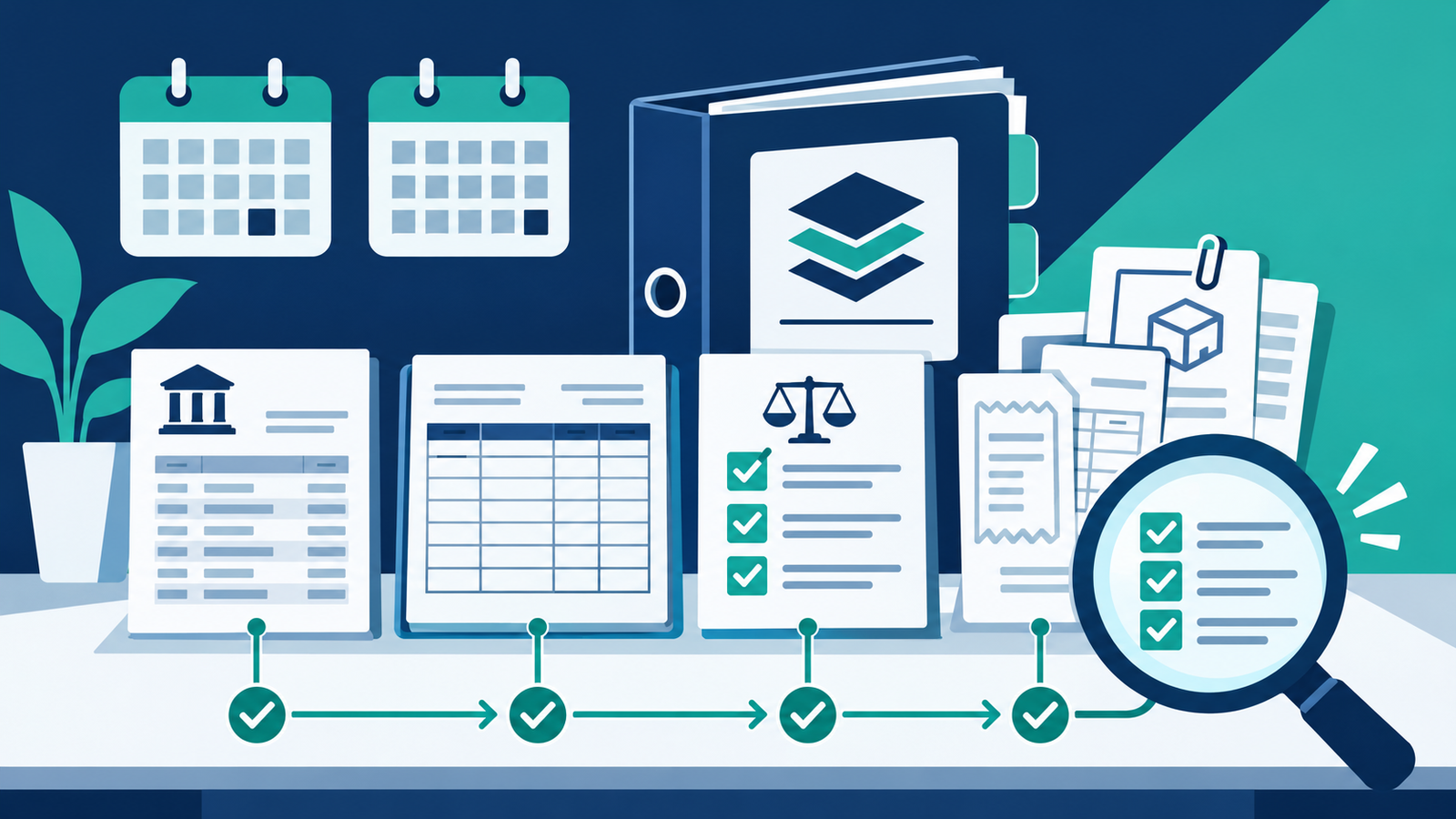
Direct answer: Prepare source documents that let a reviewer trace each material balance from the financial statements to the ledger and then to independent evidence. That normally includes bank and loan statements, reconciliation reports, sales and purchase records, payroll and tax reports, asset schedules, inventory evidence and a documented list of unresolved items.
What is the purpose of a close review evidence pack?
The pack should show that balances are complete, belong to the business, are recorded in the right period and agree to reliable evidence. It is not a document dump. Each file should have an owner, period and connection to a reconciliation or review question.
Use the month-end reconciliation and financial close guide as the parent process, then tailor the evidence pack to the accounts and risks of the business.
Which bank, cash and financing records are needed?
- Complete bank and credit-card statements covering the period end
- Bank reconciliation reports and outstanding-item lists
- Merchant, payment-gateway and petty-cash evidence
- Loan statements, repayment schedules and interest details
- Evidence for transfers between accounts
- Support for old unpresented payments or deposits
The ATO recommends regular record keeping and bank reconciliation. For each outstanding item, record the date, amount, explanation, expected clearing date and action owner.
Which sales, receivable and revenue records help?
Provide sales reports, issued invoices and credit notes, aged receivables, receipts after period end and support for material manual revenue entries. Reconcile ecommerce, POS or merchant totals to the ledger where relevant.
Identify disputed debts, unapplied receipts and unusual negative balances. A reviewer needs enough evidence to test cutoff and collectability, not simply the closing debtor total.
Which purchases, payables and expense records help?
Provide supplier statements, purchase invoices, credit notes, aged payables, expense claims, recurring-charge schedules and payments after period end. Flag goods or services received but not yet invoiced and costs paid in advance.
Retain the date, amount, description, business purpose and GST information needed to understand transactions. Do not create missing documents after the fact; record the gap and seek a replacement or alternative evidence.
Which payroll, tax and balance-sheet schedules are needed?
- Payroll summary and payroll-to-ledger reconciliation
- PAYG withholding, super and leave liability schedules
- BAS or GST workpapers and lodged statement copies
- Fixed-asset register and depreciation schedule
- Inventory count sheets and valuation method
- Accrual, prepayment and provision schedules
- Director, owner or related-party account support
Tie each schedule to the general ledger and explain reconciling items. Keep assumptions and calculations, not only the final journal.
How should the pack be organised and reviewed?
Use a consistent folder and filename convention with the entity, period, account and version. Maintain a close checklist showing preparer, reviewer, due date, evidence link, status and unresolved item. Lock the approved period according to the business’s control policy, while preserving a controlled method for later corrections.
For scope boundaries, compare the guide on month-end and year-end close service scope. The Bookkeeping and Financial Reporting service page and homepage provide related resources.
Practical checklist
- Confirm the entity and exact close date
- Download full bank, card and loan statements
- Export reconciliation and outstanding-item reports
- Prepare receivable and payable aging with explanations
- Reconcile payroll, super, PAYG and GST balances
- Update assets, inventory, accruals and prepayments
- Attach support for material manual journals
- Record missing evidence and assign an owner
- Obtain preparer and reviewer sign-off
- Archive the final pack and change log
Hypothetical example
Hypothetical example only: An Epping retailer prepares its June close. The owner supplies bank and merchant statements, a stock count, June supplier invoices received in July and the payroll liability report. The bookkeeper links each file to the checklist. One old deposit cannot be explained, so it remains on the exceptions register rather than being cleared without evidence.
Frequently asked questions
Do you need every invoice for a monthly review?
The required depth depends on risk and scope, but material balances and sampled transactions need sufficient source evidence, and records must meet legal retention rules.
What if a statement is missing?
Record the gap, request a replacement from the issuer, use reliable alternative evidence if appropriate and keep the reviewer informed.
Should the evidence pack change at year end?
Usually yes. Year end often adds tax workpapers, asset and inventory evidence, provisions, related-party balances and external adviser requests.
Sources checked
- ATO – When to do record-keeping and reporting tasks
- ATO – Overview of record-keeping rules for business
- Australian Government – Record keeping for business
Published by TNS Accounting. Source check completed 20 November 2026. This general information does not replace advice for your circumstances.







One Response