
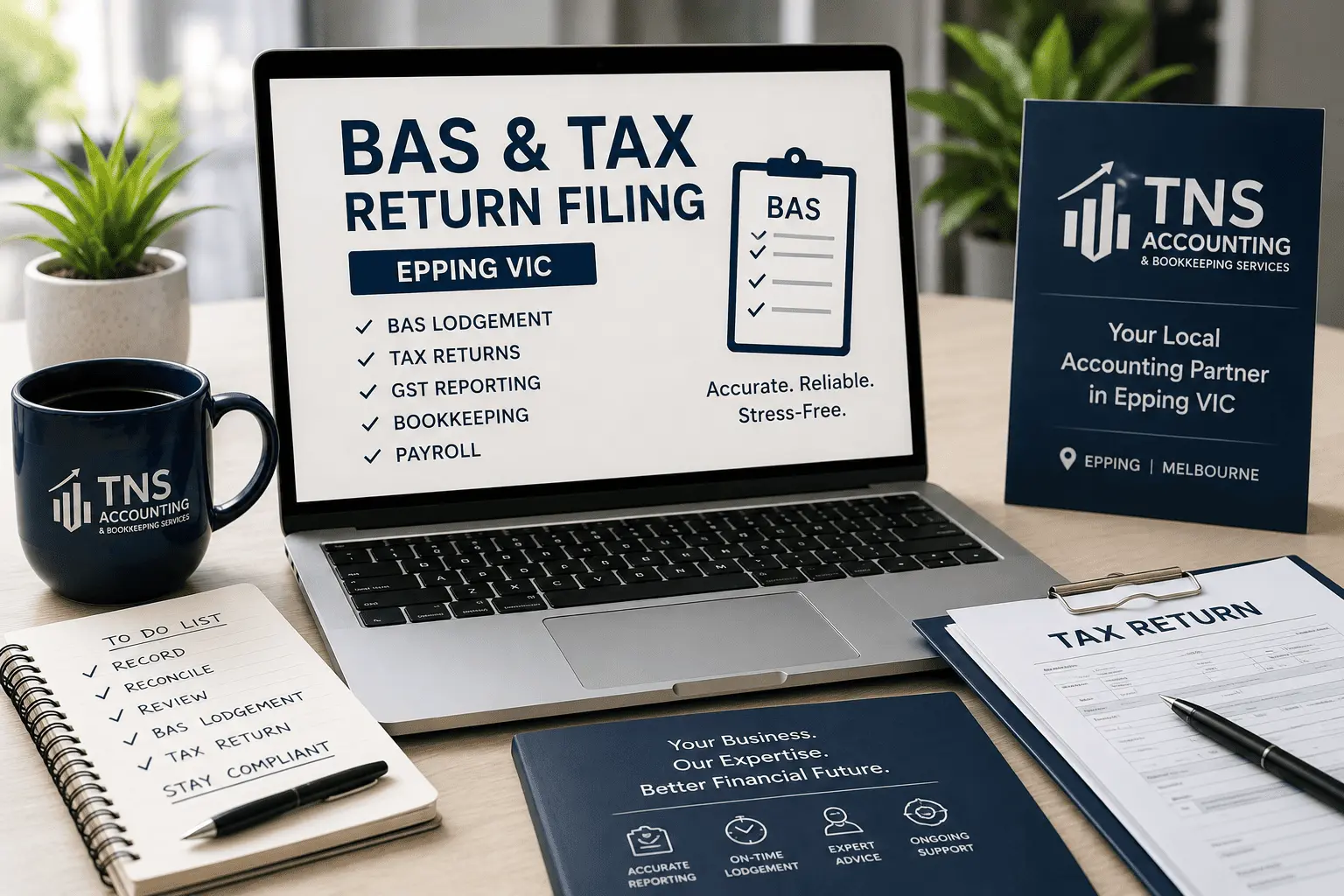
Running a successful business requires more than delivering quality products or services. Every business owner must also manage financial records, meet tax obligations, and stay compliant with Australian Taxation Office (ATO) requirements. From lodging your Business Activity Statement (BAS) to preparing annual tax returns, every reporting obligation plays an important role in keeping your business financially healthy and legally compliant.
Many small businesses in Epping VIC start by managing their own bookkeeping and tax reporting. While this may seem manageable in the early stages, increasing sales, additional employees, GST obligations, and changing tax regulations often make financial management far more complex. Even a small mistake in your BAS or tax return can lead to unnecessary penalties, delayed refunds, or additional enquiries from the ATO.
Professional accounting support removes much of this burden. Instead of spending valuable time understanding tax legislation and preparing financial reports, business owners can focus on serving customers, expanding their operations, and achieving long-term growth.
At TNS Accounting & Bookkeeping Services, we understand the challenges faced by Australian small businesses. Our team provides reliable bookkeeping, BAS preparation, payroll support, GST reporting, and tax return services tailored to each client’s unique requirements. Whether you’re operating as a sole trader, partnership, company, or trust, having experienced professionals manage your financial obligations provides confidence that everything is prepared accurately and submitted on time.
In this guide, we’ll explore the advantages of professional BAS and tax return services, explain why local businesses benefit from expert accounting support, and discuss how personalised financial solutions help businesses across Epping and Melbourne remain organised throughout the financial year.
Benefits of Professional BAS & Tax Return Services
Managing BAS and tax returns involves much more than entering numbers into accounting software. Every transaction recorded throughout the year contributes to your financial reports, GST calculations, and annual tax obligations. Without accurate bookkeeping and regular financial reviews, businesses can easily overlook important details that affect compliance and profitability.
Professional BAS and tax return services provide business owners with peace of mind by ensuring financial information is prepared correctly before it is submitted to the Australian Taxation Office. Experienced accounting professionals understand current taxation legislation, reporting requirements, and available deductions, helping businesses reduce errors while maintaining full compliance.
One of the greatest benefits of working with professionals is accuracy. Every invoice, receipt, payroll record, and business expense is reviewed carefully to ensure information reported to the ATO reflects the true financial position of the business. Accurate reporting reduces the likelihood of amendments, audits, and costly mistakes that could otherwise impact cash flow.
Professional support also saves valuable time. Business owners often spend hours organising paperwork, reconciling accounts, and researching taxation rules that change regularly. By outsourcing these responsibilities, they can focus on growing their business while experienced accountants handle the financial administration.
Another significant advantage is improved financial visibility. Regular bookkeeping and reporting provide clear insights into business performance, allowing owners to monitor revenue, expenses, profitability, and cash flow throughout the year. Instead of waiting until tax time to understand the financial position of the business, they have access to accurate information whenever decisions need to be made.
Working with an accounting professional can also improve financial planning. Rather than simply preparing BAS and tax returns at the last minute, accountants help businesses identify opportunities to improve cash flow, plan for tax liabilities, and prepare for future growth.
Benefits of Hiring a Registered BAS Agent
Although accounting software has made bookkeeping more accessible, software alone cannot replace professional expertise. A registered BAS Agent has the qualifications and authority to prepare and lodge Business Activity Statements while ensuring compliance with Australian tax regulations.
Hiring a registered BAS Agent offers several important advantages. They understand the latest ATO requirements, helping businesses avoid common reporting errors that may lead to penalties or delays. They also ensure GST has been recorded correctly, payroll information is complete, and financial records accurately reflect business activity.
A registered BAS Agent can identify discrepancies before lodgement, reducing the need for future corrections. If issues arise, they can also assist with communicating with the ATO and resolving reporting concerns efficiently.
Professional support is particularly valuable for growing businesses where financial transactions become increasingly complex. As staff numbers increase, inventory expands, or new services are introduced, maintaining accurate financial records requires consistent attention and expertise.
By working with experienced professionals, business owners gain confidence that their reporting obligations are managed correctly while freeing valuable time to focus on serving customers and expanding operations.
BAS & Tax Return Filing for Small Businesses in Epping VIC
Small businesses form the backbone of the local economy in Epping VIC. From retail stores and cafés to construction companies, consultants, healthcare providers, and tradespeople, every business has financial reporting responsibilities that must be managed carefully throughout the year.
Unlike larger organisations with dedicated finance departments, many small businesses rely on owners or small teams to manage bookkeeping, payroll, invoicing, and tax reporting alongside their daily operations. As workloads increase, maintaining accurate financial records often becomes more challenging.
Professional BAS and tax return support helps reduce this pressure by ensuring bookkeeping remains organised throughout the financial year. Rather than rushing to collect invoices and reconcile accounts before every reporting deadline, businesses can rely on structured financial processes that make compliance significantly easier.
Regular financial reporting also supports better decision-making. Business owners gain a clearer understanding of operating costs, revenue trends, outstanding payments, and profitability, allowing them to respond quickly to changing market conditions.
Small businesses also benefit from proactive tax planning. Identifying deductible expenses, monitoring GST obligations, and preparing for future tax liabilities throughout the year helps avoid unexpected financial surprises at tax time.
Instead of viewing BAS and tax returns as administrative tasks, successful businesses recognise them as valuable opportunities to review financial performance and strengthen long-term business planning.
Why Local Businesses in Epping Trust TNS Accounting
Choosing a local accounting partner offers advantages that extend beyond preparing BAS and annual tax returns.
At TNS Accounting & Bookkeeping Services, we understand the unique challenges faced by businesses operating in Epping VIC and the surrounding Melbourne suburbs. We take the time to understand each client’s business structure, industry, reporting obligations, and long-term goals before recommending practical accounting solutions.
Rather than offering a one-size-fits-all service, we focus on building lasting relationships based on reliability, transparency, and personalised support. Our clients know they can rely on us throughout the year—not only during BAS or tax return season.
We also believe in clear communication. Tax legislation can sometimes feel confusing, particularly for new business owners. Our team explains reporting requirements in straightforward language, helping clients understand their obligations while making informed financial decisions with confidence.
Supporting Businesses Across Melbourne
Although we proudly support businesses in Epping, our services also extend to clients across Melbourne. Advances in cloud accounting software have made professional bookkeeping and accounting support more accessible than ever, allowing businesses to receive timely assistance regardless of their location.
Whether your business operates from a retail shop, office, warehouse, construction site, or home office, reliable accounting processes remain essential for maintaining compliance and supporting growth.
We assist businesses across a wide range of industries, adapting our services to suit their reporting requirements, operational needs, and future objectives.
Personalised Accounting Solutions
Every business is different, which is why personalised accounting support delivers better long-term results than generic bookkeeping services.
At TNS Accounting & Bookkeeping Services, we tailor our services to match the size, structure, and goals of each client. Some businesses require complete bookkeeping and payroll management, while others simply need assistance with BAS preparation or annual tax returns.
As businesses grow, their accounting requirements often change. We provide flexible support that evolves alongside your business, helping ensure financial systems continue to meet operational needs and ATO requirements.
By combining accurate bookkeeping, professional BAS preparation, tax return services, payroll support, and ongoing financial guidance, we help business owners remain organised throughout the year while reducing administrative workload and improving financial confidence.
Partnering with an experienced accounting team means you can spend less time worrying about compliance and more time focusing on growing your business, serving your customers, and planning for the future.
BAS Services for Sole Traders
Starting a business as a sole trader is one of the most common ways to enter the Australian market. While this business structure is relatively simple to establish, it still comes with important financial and taxation responsibilities. Sole traders are responsible for maintaining accurate financial records, tracking income and expenses, meeting GST obligations where applicable, and lodging BAS and annual tax returns on time.
Many sole traders manage every aspect of their business themselves—from finding clients and completing projects to invoicing customers and handling administration. As the business grows, keeping up with bookkeeping and tax reporting can become increasingly time-consuming.
Professional BAS and bookkeeping support helps sole traders stay organised throughout the financial year. Instead of trying to prepare reports just before lodgement deadlines, financial records are maintained consistently, making BAS preparation faster and more accurate.
Accurate bookkeeping also provides valuable insight into business performance. By monitoring revenue, expenses, and cash flow regularly, sole traders can make informed decisions about pricing, budgeting, equipment purchases, and future business growth.
Another advantage of professional accounting support is identifying legitimate business deductions. Many sole traders miss deductible expenses because records are incomplete or receipts have not been properly stored. Maintaining organised documentation throughout the year helps ensure eligible claims are supported and reported correctly.
Working with experienced professionals also reduces the stress associated with tax time, allowing sole traders to concentrate on building their business while their financial reporting remains compliant with ATO requirements.
BAS Services for Companies
Companies generally have more complex accounting responsibilities than sole traders. As businesses expand, financial transactions increase, employee numbers grow, and reporting obligations become more detailed.
Company BAS preparation often includes GST reporting, PAYG withholding, payroll reporting, superannuation obligations, and maintaining accurate accounting records across multiple business activities.
Professional BAS services help companies establish reliable financial systems that support accurate reporting throughout the year. Instead of relying solely on year-end accounting, regular bookkeeping ensures financial information remains current and readily available.
Monthly financial reporting also enables company directors to monitor business performance more effectively. Reviewing income, expenses, profit margins, and outstanding liabilities on a regular basis allows management to make strategic decisions supported by reliable financial information.
Companies also benefit from professional tax planning. Understanding expected tax liabilities before the end of the financial year allows businesses to prepare financially rather than facing unexpected tax bills after lodgement.
As companies continue to grow, maintaining organised financial records becomes increasingly important. Professional accounting support helps ensure compliance while creating a strong financial foundation for future expansion.
BAS Services for Partnerships
Partnership businesses combine the skills and resources of two or more individuals working together toward common business objectives. While partnerships share business income and responsibilities, they must also maintain accurate accounting records and meet Australian taxation requirements.
Effective bookkeeping is particularly important for partnerships because it provides transparency between partners and ensures financial information is accurate when preparing BAS and annual tax returns.
Professional BAS services help partnerships record business transactions consistently, reconcile bank accounts, manage GST obligations, and prepare financial reports that accurately reflect business performance.
Clear financial reporting also supports better communication between partners by providing up-to-date information regarding income, expenses, profitability, and business cash flow.
Partnerships often experience periods of growth that introduce additional complexity, including employing staff, purchasing equipment, or expanding services. Professional bookkeeping ensures accounting systems continue to support these changes while maintaining compliance with ATO requirements.
Rather than spending valuable business hours managing financial administration, partners can focus on developing the business while experienced accounting professionals maintain accurate financial records.
BAS Services for Trusts
Trusts have unique taxation and reporting obligations that require careful financial management throughout the year. Depending on the structure and activities of the trust, BAS preparation may involve GST reporting, PAYG obligations, investment income, business transactions, and distribution records.
Because trust accounting can be more complex than other business structures, maintaining accurate records is essential for ensuring compliance and preparing reliable financial reports.
Professional BAS services help trustees maintain organised accounting records while ensuring GST calculations and taxation information are prepared accurately before lodgement.
Regular bookkeeping also provides greater visibility over trust income, expenses, investments, and distributions, making year-end reporting significantly more efficient.
Seeking professional guidance helps trustees understand their reporting obligations while reducing the likelihood of errors that may affect compliance with Australian taxation legislation.
Digital Record Keeping
Modern businesses generate large volumes of financial information every day. Sales invoices, supplier bills, payroll reports, receipts, bank transactions, and GST records all contribute to accurate BAS preparation and annual tax reporting.
Digital record keeping has transformed the way businesses manage this information. Rather than relying on paper files and manual spreadsheets, cloud-based accounting systems allow business owners to securely store financial records in one central location.
Digital accounting offers several advantages, including:
- Faster access to financial information.
- Reduced paperwork.
- Improved accuracy.
- Automatic transaction recording.
- Secure document storage.
- Easier collaboration with accountants.
- Real-time financial reporting.
Maintaining digital records also simplifies document retrieval should the ATO request supporting information during a review.
Businesses that consistently update their accounting software throughout the year generally experience a smoother BAS preparation process with fewer reporting delays.
BAS Review Before Lodgement
Preparing BAS is only part of the reporting process. Before lodging any statement with the Australian Taxation Office, it is important to carefully review the information for accuracy.
A thorough BAS review helps identify issues before submission, reducing the likelihood of amendments or ATO enquiries.
During a review, accountants typically confirm:
- Sales have been recorded correctly.
- GST calculations are accurate.
- Purchases are categorised appropriately.
- Payroll information matches accounting records.
- PAYG obligations have been reported correctly.
- Bank reconciliations are complete.
- Supporting documentation is available.
Taking the time to perform these checks provides greater confidence that BAS information accurately reflects the business’s financial activity.
For businesses with regular transactions, this review process is an important safeguard against reporting errors.
Correcting BAS Errors
Despite careful bookkeeping, mistakes can occasionally occur. Transactions may be entered incorrectly, invoices may be overlooked, or GST may be coded under the wrong category.
The important thing is identifying these issues promptly and correcting them appropriately.
Common BAS errors include:
- Duplicate transactions.
- Missing supplier invoices.
- Incorrect GST coding.
- Reporting sales in the wrong period.
- Misclassified business expenses.
- Payroll reporting discrepancies.
Regular bookkeeping reviews throughout the year help detect these issues early before they become larger compliance concerns.
Where adjustments are required, accounting professionals can determine the appropriate method of correcting previous BAS information while ensuring future reports remain accurate.
Rather than allowing small bookkeeping mistakes to accumulate over several reporting periods, businesses benefit from ongoing financial reviews that maintain reliable accounting records year-round.
By combining accurate bookkeeping, digital record management, routine reconciliations, and professional BAS reviews, businesses establish strong financial processes that support compliance, improve reporting accuracy, and simplify future tax obligations. These proactive practices not only reduce administrative stress but also provide business owners with greater confidence when making financial decisions and planning for sustainable growth.
GST and BAS Reporting Explained
Goods and Services Tax (GST) is one of the key components of Australia’s taxation system and an important part of Business Activity Statement (BAS) reporting. If your business is registered for GST, you’re responsible for collecting GST on taxable sales, claiming GST credits on eligible business purchases, and reporting these amounts accurately to the Australian Taxation Office (ATO).
Understanding how GST works is essential for maintaining compliance and avoiding reporting errors. Every taxable transaction recorded in your accounting system contributes to your BAS, making accurate bookkeeping a vital part of the reporting process.
For example, when your business sells products or services that attract GST, you collect the tax from your customers on behalf of the ATO. At the same time, when your business purchases goods or services for business purposes, you may be able to claim GST credits for eligible expenses. During each BAS reporting period, these amounts are calculated to determine whether your business needs to pay GST to the ATO or is entitled to a refund.
Incorrect GST reporting can lead to unnecessary delays, amendments, and compliance issues. Common errors include applying the wrong GST code, failing to record tax invoices correctly, or claiming GST credits on ineligible expenses. Maintaining organised financial records and reviewing transactions regularly helps reduce these risks.
Modern accounting software makes GST reporting easier by automatically tracking GST on sales and purchases. However, software is only as accurate as the information entered. Regular bookkeeping and professional oversight help ensure transactions are categorised correctly before BAS is prepared.
At TNS Accounting & Bookkeeping Services, we assist businesses with accurate GST reporting, BAS preparation, and ongoing bookkeeping support. Our goal is to help business owners stay compliant while simplifying their day-to-day financial management.
PAYG Withholding and BAS
If your business employs staff, PAYG (Pay As You Go) withholding becomes another important responsibility that forms part of your BAS reporting.
PAYG withholding requires employers to withhold a portion of an employee’s wages and remit that amount to the ATO. These withholdings contribute towards the employee’s income tax obligations and must be reported accurately during each BAS period.
In addition to employee wages, PAYG withholding may also apply to certain contractor payments and other situations depending on ATO requirements.
Accurate payroll processing is essential because incorrect PAYG reporting can affect both the employer and employees. Errors may result in incorrect tax payments, payroll discrepancies, or additional administrative work to resolve reporting issues.
To maintain compliance, businesses should:
- Process payroll accurately and on time.
- Keep employee records up to date.
- Record PAYG withholding correctly.
- Ensure payroll figures match accounting records.
- Review payroll reports before BAS lodgement.
Integrating payroll with bookkeeping systems provides greater accuracy and reduces manual data entry. Regular reviews also help identify discrepancies before they become larger compliance concerns.
Professional bookkeeping support allows employers to manage payroll obligations with confidence while ensuring PAYG information reported to the ATO remains accurate.
PAYG Instalments Explained
While PAYG withholding relates to employee wages, PAYG instalments operate differently. PAYG instalments are regular payments made towards a business’s expected income tax liability for the current financial year.
Rather than paying the full amount of income tax at the end of the financial year, eligible businesses make instalment payments throughout the year. This spreads tax obligations across multiple reporting periods and can assist with cash flow management.
The ATO generally determines whether a business enters the PAYG instalment system based on its income and tax history.
Businesses should understand:
- When PAYG instalments apply.
- How instalments are calculated.
- When payments are due.
- How instalments affect year-end tax returns.
Regular financial reporting makes it easier to monitor expected tax liabilities and prepare for future instalment payments.
Business owners who understand their ongoing tax obligations are generally better positioned to budget effectively and avoid unexpected financial pressure during tax season.
Professional accounting advice also helps businesses review instalment amounts where circumstances have changed, ensuring payments remain appropriate for current trading conditions.
How to Prepare for Tax Time
Preparing for tax time should not begin a few weeks before the lodgement deadline. Effective preparation is a year-round process that starts with maintaining organised financial records from the beginning of the financial year.
Businesses that adopt consistent bookkeeping practices experience a far smoother tax preparation process than those trying to organise months of financial information at the last minute.
Preparing for tax time involves more than gathering receipts. It includes reviewing business income, confirming deductible expenses, reconciling bank accounts, checking payroll records, verifying GST information, and ensuring supporting documentation is complete.
Some practical ways to prepare include:
- Recording transactions regularly.
- Keeping digital copies of invoices and receipts.
- Reconciling bank accounts every month.
- Reviewing financial reports frequently.
- Monitoring GST obligations.
- Keeping payroll records current.
- Tracking deductible expenses throughout the year.
- Meeting BAS lodgement deadlines.
Businesses that follow these practices throughout the year generally experience fewer reporting errors and reduced stress during tax season.
Tax Planning Tips
Tax planning is an important part of effective financial management and should not be limited to the end of the financial year. Regular reviews of business performance allow owners to make informed decisions before tax obligations become due.
Some practical tax planning strategies include:
- Reviewing business performance throughout the year.
- Monitoring cash flow regularly.
- Planning for expected tax liabilities.
- Keeping accurate records of deductible expenses.
- Reviewing business asset purchases.
- Ensuring payroll obligations are current.
- Seeking professional advice before major financial decisions.
Tax planning is not about avoiding tax—it is about understanding your obligations, managing finances effectively, and ensuring your business is prepared for upcoming reporting requirements.
Professional accountants can also identify opportunities for improved financial efficiency while ensuring businesses remain fully compliant with Australian taxation legislation.
End of Financial Year Checklist
As the financial year comes to an end, reviewing your accounting records helps ensure everything is ready before preparing your tax return.
An effective end-of-year checklist should include:
- Confirm all business income has been recorded.
- Reconcile every business bank account.
- Review outstanding invoices.
- Organise receipts and supporting documents.
- Verify GST records.
- Check payroll reports.
- Confirm superannuation obligations have been met.
- Review asset purchases.
- Identify deductible expenses.
- Prepare financial reports for tax return preparation.
Completing these tasks before meeting with your accountant saves time, reduces the likelihood of reporting errors, and creates a more efficient tax preparation process.
Rather than rushing to gather paperwork after the financial year ends, businesses that maintain organised records throughout the year are able to prepare their tax returns with greater confidence and accuracy.
Conclusion
Managing BAS, GST reporting, payroll obligations, and annual tax returns requires ongoing attention, accurate bookkeeping, and a clear understanding of Australian taxation requirements. While these responsibilities are essential for every business, they don’t have to become a source of stress or uncertainty.
Developing strong financial processes throughout the year allows businesses to stay organised, meet ATO deadlines, and make informed decisions based on reliable financial information. Whether you’re a sole trader, partnership, company, or trust, consistent bookkeeping and timely reporting lay the foundation for long-term business success.
Partnering with experienced professionals also gives you access to practical advice, accurate financial reporting, and ongoing support as your business grows. Instead of reacting to tax deadlines, you can take a proactive approach that improves cash flow, reduces compliance risks, and helps you plan confidently for the future.
At TNS Accounting & Bookkeeping Services, we’re committed to supporting businesses across Epping VIC and the wider Melbourne region with reliable bookkeeping, BAS preparation, payroll management, GST reporting, and annual tax return services. We take the time to understand your business, tailor our services to your needs, and provide practical solutions that simplify your financial responsibilities.
Whether you’re launching a new venture, expanding an existing business, or looking for trusted accounting support, our experienced team is here to help. Contact TNS Accounting & Bookkeeping Services today to learn how we can help you stay compliant, improve your financial management, and focus on what matters most—growing your business with confidence.
TNS Accounting • Frequently Asked Questions
Frequently Asked Questions About Business Tax and BAS Support
These questions cover annual tax returns, deductions, BAS reconciliation, PAYG, year-end records and common decisions faced by small businesses in Epping and across Melbourne.
Business Tax Return Basics
Is a business tax return the same as a BAS?
No. A BAS reports periodic obligations such as GST and PAYG amounts, while a tax return reports annual income, deductions and taxable results. Figures should reconcile, but the forms have different purposes.
Does a sole trader lodge a separate business tax return?
A sole trader generally reports business income and expenses in the business section of the individual income tax return rather than lodging a separate company-style income tax return.
Does a company lodge its own tax return?
Yes. A company is a separate legal taxpayer and generally lodges a company tax return for its income year. Owners and directors may also have personal tax-return obligations.
Do partnerships and trusts have separate tax reporting obligations?
Partnerships and trusts generally have their own annual return or reporting requirements, with income then allocated according to the relevant tax rules. The treatment differs from sole traders and companies.
When is a business tax return due?
Due dates vary according to entity type, lodgement history and whether a registered tax agent is used. Check the ATO due date that applies to the specific business rather than relying on a generic calendar date.
Should BAS be up to date before preparing a tax return?
It is good practice to bring activity statements up to date first because GST and other reported figures need to reconcile with the accounting records used for the annual tax return.
Business Deductions and Expense Questions
What makes a business expense tax deductible?
An expense generally needs a sufficient connection to earning assessable business income and cannot be private, domestic or capital unless the tax law allows a deduction or depreciation treatment. Keep records that show what was spent and why.
Can I claim the private portion of a mixed business expense?
No. Where an expense has both business and private use, only the eligible business portion is generally deductible. Keep a reasonable basis for the apportionment.
Can a business claim motor vehicle expenses?
Eligible business-use vehicle costs may be deductible, but the method and evidence depend on the entity and how the vehicle is used. Maintain records that support the business-use calculation.
Are new equipment and assets always deductible immediately?
Not always. Some purchases may qualify for an immediate deduction under current rules, while others need to be depreciated over time. The treatment depends on the asset, cost, business eligibility and law for the relevant year.
Can I claim a deduction without a receipt?
Record-keeping exceptions exist in limited situations, but they do not create an automatic deduction. You still need evidence that the expense was incurred and that it was connected to earning business income.
Are fines and penalties deductible business expenses?
Many government fines and penalties are not deductible even when they arise during business activities. Check the specific payment rather than coding every business-related charge as deductible.
End-of-Financial-Year Records and Reconciliation
What records should a small business prepare for tax time?
Prepare reconciled bank and card accounts, sales records, supplier bills, payroll reports, asset purchases and disposals, loan balances, stock information where relevant, and evidence for deductible expenses.
How long should tax records be kept?
Business records generally need to be kept for five years after they are prepared or obtained, or after the related transaction is completed, whichever is later. Some records, including certain asset and capital-gains records, can need longer retention.
Why is bank reconciliation important before a tax return?
Reconciliation confirms that accounting transactions agree with bank activity and helps identify omissions, duplicates or coding errors before annual profit and tax figures are finalised.
Should outstanding invoices be reviewed at year end?
Yes. Review receivables and payables so the accounting file reflects genuine outstanding amounts and incorrect, duplicated or unrecoverable items can be investigated before final reports are prepared.
Do payroll records need to be checked before year-end tax work?
Yes. Reconcile wages, PAYG withholding, superannuation records and payroll clearing accounts, and ensure required payroll finalisation processes have been completed for employees.
Should business loans and owner transactions be reviewed at year end?
Yes. Loan balances, drawings, contributions, director or shareholder transactions and repayments should be correctly classified because misposted personal or financing transactions can distort taxable profit.
How BAS and Tax Return Figures Work Together
Why should BAS figures reconcile with annual accounts?
BAS reports draw from the same underlying sales, purchases and payroll records used in annual accounts. Reconciliation helps identify timing differences, coding mistakes and missing transactions before a tax return is lodged.
What if my BAS sales do not match the profit and loss statement?
A difference does not automatically mean something is wrong because GST, reporting methods and timing can create legitimate variations. The difference should still be explained and reconciled rather than ignored.
Can an old BAS mistake affect my tax return?
Yes. Incorrect sales, purchases or payroll coding can flow into annual accounts as well as BAS reports. Correct the accounting records and determine whether a BAS correction or revision is also required.
Should I lodge a tax return if earlier BAS statements are overdue?
It is usually better to bring activity-statement obligations up to date first so annual figures can be reconciled properly. If deadlines are approaching, discuss the order of action with the ATO or a registered practitioner.
Is GST collected from customers the same as business profit?
No. GST collected is generally a tax amount accounted for through the GST system rather than a measure of business profit. Management reports should separate GST from operating performance where appropriate.
Why can BAS and tax return amounts cover different periods?
BAS periods may be monthly or quarterly, while income tax reporting is annual. Timing rules can also differ, so year-end reconciliation may need to bridge multiple BAS periods and accounting cut-off dates.
PAYG Instalments, Withholding and ATO Payments
What are PAYG instalments?
PAYG instalments are periodic prepayments toward expected income tax on business or investment income. The amounts are credited when the relevant annual tax return is assessed.
What is the difference between PAYG instalments and PAYG withholding?
PAYG instalments prepay your own expected income tax, while PAYG withholding is tax withheld from payments made to employees and certain other payees and then remitted to the ATO.
Can PAYG instalments be varied?
The ATO allows variations in appropriate circumstances when the standard instalment does not reflect expected tax. Variations should be based on a reasonable estimate because underestimating can have interest consequences.
What happens if PAYG instalments are higher than the final tax bill?
Instalments paid during the year are credited against the final assessed tax liability. If total credits exceed the liability, the excess may contribute to a refund after other ATO debts are considered.
Can I arrange a payment plan for an ATO tax debt?
Payment arrangements may be available depending on the debt and circumstances. Lodge outstanding returns and statements first, then contact the ATO early because interest can continue to apply while a debt remains unpaid.
Should I budget for tax throughout the year?
Yes. Setting aside cash for GST, PAYG and expected income tax helps prevent tax liabilities from competing with payroll, suppliers and other operating costs when due dates arrive.
Tax Questions When a Business Changes
What tax steps should I review when starting a new business?
Review the correct business structure, ABN, GST registration, PAYG obligations, record-keeping systems and accounting software setup. Getting the registrations and chart of accounts right early reduces later cleanup.
What happens if my turnover reaches the GST threshold during the year?
For most businesses, GST registration becomes compulsory when current or projected GST turnover reaches $75,000. Monitor turnover regularly so registration is not delayed after the threshold rules are met.
What should I review before changing business structure?
Changing from sole trader to company, partnership or trust can affect registrations, ownership of assets, contracts and tax outcomes. Obtain professional advice before transferring assets or closing old registrations.
What tax obligations arise when I hire my first employee?
Review PAYG withholding, Single Touch Payroll, superannuation, workers compensation and payroll record requirements. Payroll should be integrated with the accounting system from the first pay cycle.
What should I do when closing a business?
Finalise outstanding BAS, tax returns, payroll and employee obligations, settle tax debts where possible, retain records, and then cancel registrations such as GST and the ABN when appropriate.
Do online or overseas sales still need to be included in business records?
Yes. Business income should be recorded regardless of how customers pay or where the platform is located. GST treatment can differ for exports, digital supplies and overseas transactions, so classify them carefully.
Working With an Accountant or Registered Tax Agent
What should I prepare before meeting an accountant at tax time?
Provide a reconciled accounting file, bank and card statements, payroll reports, asset and loan records, expense evidence, prior ATO correspondence and explanations for unusual or one-off transactions.
Can a BAS agent prepare an income tax return?
A registered BAS agent’s scope is focused on BAS services and related matters. Income tax return preparation and advice for a fee generally falls within registered tax-agent services.
How can I check whether a tax practitioner is registered?
Use the Tax Practitioners Board public register to verify whether a person or practice is registered and what type of registration they hold before engaging them for regulated tax services.
When should I ask for a tax return amendment?
If a lodged return contains a material omission or incorrect amount, review whether an amendment is required within the applicable review period. Correct supporting records before submitting the change.
What should I do if the ATO sends a review or information request?
Read the notice carefully, note the response deadline, gather the requested records and respond accurately. Seek registered professional assistance if the issue is unclear, significant or connected to earlier reporting errors.
Is it better to see an accountant only at tax time?
For many businesses, periodic reviews are more useful because bookkeeping, GST, payroll, cash flow and tax planning issues can be corrected before year end rather than after they have accumulated.
Year-Round Tax Planning for Epping Businesses
What is tax planning for a small business?
Tax planning is the process of reviewing expected income, expenses, cash flow and upcoming obligations before year end so decisions can be made with a clearer understanding of their legitimate tax consequences.
How often should a small business review its tax position?
Quarterly reviews work well for many businesses because they align with common BAS cycles. Faster-growing or cash-sensitive businesses may benefit from monthly management reporting and tax forecasting.
How can accounting software support tax planning?
Cloud accounting software can provide current profit, cash flow, receivables and tax reports when transactions are coded and reconciled correctly. Reliable data makes forecasts more useful.
What are common tax-time mistakes small businesses make?
Common issues include unreconciled bank accounts, missing income, private expenses claimed as business costs, duplicate transactions, incomplete payroll records, unsupported deductions and leaving record cleanup until the deadline.
How can a business avoid a surprise tax bill?
Keep bookkeeping current, review profit throughout the year, monitor PAYG instalments and GST, forecast expected tax, and reserve cash rather than waiting until the assessment or BAS due date.
When should an Epping business seek professional tax support?
Seek help when the business is growing, changing structure, hiring staff, dealing with overdue lodgements, correcting prior reporting, receiving ATO correspondence or needing clearer year-round reporting. TNS Accounting offers BAS and tax return support, bookkeeping and accounting-system assistance for businesses in Epping and across Melbourne.
This information is general in nature and does not replace advice based on your circumstances. ATO rules, due dates and eligibility can depend on your registrations and reporting profile.

